Name:Keysight M8195A
Brand:Keysight
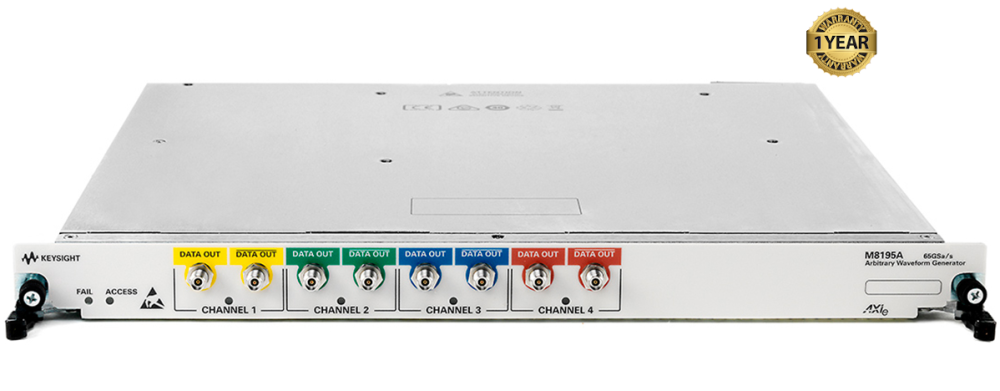

Product Details
Features
Obtain previously unavailable testing capabilities: Use real-time mode, sequence generation function, and deep memory - explore new testing areas.
Functions:
Sampling rate up to 65 GSa/s
High channel density: Each module provides 1, 2, or 4 channels. Using the M8197A multi-channel synchronization module, up to 16 channels on 4 modules can be synchronized.
Built-in frequency and phase response calibration
Embedded DSP supports real-time waveform generation and impairments (used in combination with the 81195A optical modulation generator software)
High Performance:
Each AXIe module is equipped with a 25 GHz analog bandwidth and 2 GSa memory, and can be expanded to 16 GSa.
The 16GSa extended memory can generate PRBS7, PRBS10, PRBS11, PRBS15 up to PRBS31 patterns (Calculating long PRBS patterns and loading them into the waveform memory of the arbitrary waveform generator will take a considerable amount of time).
Output amplitude up to 1 Vpp (single-ended) or 2 Vpp (differential)
Signal baud rate exceeds 32 GBaud
Pre-configured, including:
M8195A Arbitrary Waveform Generator (AWG)
AXIe chassis and embedded controller or external personal computer connectivity
M8070A system software for the M8000 series BER test solution provides more functions.
Key Applications:
As device and interface speeds continue to increase and complexity deepens, the rich functions of the M8195A Arbitrary Waveform Generator can generate the signals you need to meet the requirements of applications such as digital applications, optoelectronic communications, advanced research, broadband radar, and satellite communications.
Coherent optical communication - A single M8195A module can generate two independent I/Q baseband signals (dual polarization = 4 channels) with a baud rate reaching or exceeding 32 GBaud.
Multi-level/multi-channel digital signals - Can generate signals with a baud rate of up to 32 GBaud, such as NRZ, PAM4, PAM8, DMT, etc. It can also support protocols such as HDMI™, C-PHY™, and D-PHY™. Embed/De-embed channels, add jitter, ISI, noise, and other distortions.
Physics, chemistry, and electronics research - Generate arbitrary waveforms with strict mathematical definitions, precise ultrashort pulses, and ultra-wideband chirps.
Broadband RF/microwave - Generate ultra-wideband RF signals with an instantaneous bandwidth from DC to 25 GHz, suitable for aerospace/defense/communications fields.
For application-specific random interference (RI) sources, the M8070A is required.
The Keysight M8195A Arbitrary Waveform Generator (AWG) provides up to 4 output channels simultaneously on a single-slot AXIe module, with a sampling rate of up to 65 GSa/s, a bandwidth of up to 25 GHz, and an 8-bit vertical resolution.
As device and interface speeds become faster and structures become more complex, the rich functions of the M8195A AWG can generate the signals you need to meet the requirements of applications such as digital applications, advanced research, broadband radar, satellite communications, and fiber optic communications. The advanced 3-level sequence generation function enables longer signal scenarios. When the M8197A module needs to synchronize multiple M8195A modules, an external dynamic control option can also be used. The M8195A Arbitrary Waveform Generator provides a trigger input, and when used in combination with the M8197A multi-channel synchronization module, a time delay accuracy of ±20 ps can be achieved. When used in combination with the N5990A software options 151 and 153, the M8195A can provide an HDMI and MHL receiver test solution. The M8195A Arbitrary Waveform Generator can also be controlled by the M8070A Bit Error Rate Test System Software with the M8085A software plug-in to generate test signals compliant with MIPI C-PHY™ and D-PHY™ standards. The M8195A Arbitrary Waveform Generator, combined with the 81195A optical modulation generator software, provides an innovative real-time signal generation method that can increase your testing speed by 100 times.
It can generate signals and impairments in real time. Using FIR filters and other DSP functions, pulse shaping and changing of optical stress test conditions such as polarization mode dispersion (PMD) or phase noise can be performed. Using real-time mode, sequence generation function, and deep memory, you can break through previous limitations and explore new testing areas. Explore new opportunities.
More Products
Keysight 81960A
Views Count:16
GENERAL DOP-201
Views Count:22
Yokogawa AQ6370D
Views Count:16
R&S FSU8
Views Count:14